DOE has finally released its FY26 Fall Opportunity under the newly redesigned SBIR/STTR program. There are considerable changes to the program that will affect companies seeking DOE funding. Notably they have adopted a pitch-first approach that is similar in concept to the NSF Project Pitch process. Potential applicants are first required to submit a short Pitch where they must answer four narrative questions, three short answer questions and seven structured selection questions. The questions are intended to demonstrate your project’s technical and commercial potential; your team qualifications and how your project aligns with the DOE’s mission and priorities. This pitch is an initial screening step that will be reviewed by the DOE to determine which projects will be selected and invited to advance to the next stage of the application process and negotiate a Phase I award. The Pitch Development Guide with the template questions and an example can be found here. A single company will be allowed to submit up to three separate pitches, and each must be relevant to any one of the 25 topic areas.
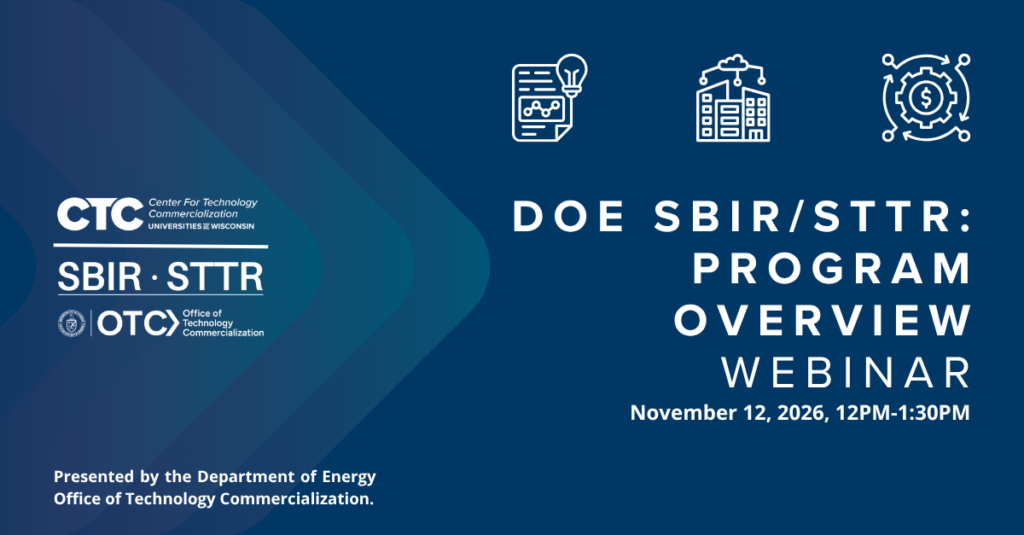
Potential applicants should join us and the DOE Office of Technology Commercialization Office (OTC) on November 12 at 12pm, or attend a virtual office hours sessions that will be held on Thursday November 19 and Tuesday December 1 at 2pm. The deadline for submitting your pitch is on December 16 at 1pm. In addition to these sessions, applicants will need to request access to the Acquisition Management Portal (AMP). This request for access to set up your account must be completed first, and we recommend that you do this as soon as possible.
Should a company be invited to submit a Phase I, the application will be evaluated based on Scientific, technical merit and feasibility; Commercial potential; and Team qualifications. In addition to these reviewer scores other program policy factors may be considered that will go into the overall determination of funding.
Awarded companies will be paid on completion of negotiated milestones. Phase II will be awarded based on success of completing the Phase I milestones. Based on the current program description, advancement from Phase I to Phase II may occur through successful completion of negotiated milestones rather than through the traditional stand-alone Phase II proposal process. However, applicants should consult future DOE guidance for details on Phase II transition requirements. There will, however, be a Phase II application for participants with existing Phase I or Phase II awards to enter into the new program format. Further information on the DOE program can be found here.
Join us November 12th!